 𝟗𝟏+𝟗𝟖𝟏𝟏𝟎𝟒𝟎𝟒𝟓𝟎 || 𝟗𝟗𝟏𝟏𝟑𝟏𝟏𝟔𝟓𝟎
  𝐢𝐧𝐩𝐮𝐫𝐞𝐮𝐧𝐢𝐭@𝐠𝐦𝐚𝐢𝐥.𝐜𝐨𝐦
𝐃𝐦 𝐏𝐥𝐚𝐧𝐭
𝐃𝐞-𝐌𝐢𝐧𝐫𝐚𝐥𝐢𝐳𝐚𝐭𝐢𝐨𝐧 𝐏𝐥𝐚𝐧𝐭
DM PLANTS by INPURE UNIT – Delivering Ultra-Pure Water Since 2015
In today’s highly sensitive industrial, pharmaceutical, and laboratory environments, the demand for ultra-pure water is not optional—it is critical. Processes in pharmaceuticals, electronics, power generation, chemical manufacturing, and research laboratories can be severely compromised by even trace amounts of dissolved minerals, salts, or ionic contaminants. These impurities can reduce process efficiency, damage equipment, and violate quality standards.
This is where De-Mineralization Plants (DM Plants) play a vital role. At INPURE UNIT, we specialize in engineering reliable, high-performance DM Plants designed to meet the most stringent purity standards. With over a decade of experience in advanced water treatment technologies, we provide tailored solutions backed by national service coverage and a strong focus on performance, sustainability, and compliance.
About INPURE UNIT – A Decade of Purity and Trust
Established in 2015, INPURE UNIT is an ISO 9001-certified water treatment company delivering turnkey systems such as Reverse Osmosis (RO) Plants, Effluent Treatment Plants (ETP), Sewage Treatment Plants (STP), Hydro Pneumatic Systems (HTP), UV and UF Disinfection Systems, Softeners, and De-Mineralization Plants across India. Our engineering team has commissioned hundreds of custom-built plants for clients in pharmaceuticals, power, food processing, hospitality, manufacturing, and research sectors.
Understanding DM Technology – What is a DM Plant?
A De-Mineralization Plant is a specialized water purification system designed to remove dissolved mineral salts and ions—including calcium, magnesium, sodium, chloride, nitrate, sulfate, potassium, iron, and silica. These ions are removed through a process called ion exchange, using high-performance resins that replace cations and anions in the water with hydrogen (H⁺) and hydroxide (OH⁻) ions. The end result is high-purity, de-ionized water with very low conductivity (near-zero Total Dissolved Solids or TDS).
DM Water is essential for:
Boiler feed and steam generation
Pharmaceutical formulation and equipment cleaning
Laboratory testing and analysis
Electronics component washing
Electroplating and surface finishing
Cosmetic and personal care product manufacturing
Chemical blending and reactions
INPURE UNIT DM Plant System Design
Our DM Plants are designed for high reliability, operational efficiency, and user-friendly control. We offer a range of configurations including:
1. Two-Bed DM Plant
Separate Cation Exchange Unit to remove positively charged ions (Ca²⁺, Mg²⁺, Na⁺)
Anion Exchange Unit to remove negatively charged ions (Cl⁻, NO₃⁻, SO₄²⁻)
2. Mixed Bed DM Plant
A single pressure vessel containing both cation and anion resins for ultra-pure water
3. Automatic or Manual Regeneration Systems
With acid (HCl) and alkali (NaOH) dosing for efficient resin reuse
4. Optional Add-Ons
Degasifier Columns to remove CO₂ and improve ion exchange efficiency
Conductivity and pH Meters for real-time monitoring
PLC/SCADA Integration for fully automated control
Skid-Mounted Designs for easy installation and portability
All systems are available in FRP, Mild Steel with FRP lining, or Stainless Steel (SS 304/316) vessels based on process requirements and budget.
Key Advantages of INPURE UNIT DM Plants
Consistent Water Purity: Achieves conductivity as low as 0.1 µS/cm
High-Quality Ion Exchange Resins: Indian and imported options available with long service life and high capacity
Low Operating Costs: Optimized cycle durations and regeneration protocols
Flexible Capacities: From 500 liters per hour (LPH) to 100+ cubic meters/day
Compact and Modular: Designed for easy integration in existing water treatment lines
Corrosion-Resistant Construction: Built for long-term durability in challenging environments
Automation Ready: Compatible with SCADA, remote monitoring, and auto-regeneration
Plug-and-Play Models: Factory-assembled systems for rapid deployment
Industries & Institutions That Trust Our DM Plants
Our DM Plants serve a wide range of applications across sectors, including:
Pharmaceutical and API manufacturing facilities
Power plants and boiler feed water systems
Biotechnology and research laboratories
FMCG and cosmetic production units
Steel plants and surface finishing industries
Diagnostic labs and hospitals
Electronics and semiconductor assembly lines
Educational institutions and R&D centers
Each system complies with Indian Pharmacopoeia (IP), WHO, and client-specific water quality standards.
Why Choose INPURE UNIT for Your DM Water Needs?
More than 10 Years of Industry Experience
ISO 9001-Certified Designs and Quality Control
Custom-Engineered Solutions Based on Feed Water Analysis
Turnkey Execution – Design, supply, installation, commissioning, training
Nationwide Support – On-site service, AMC contracts, and emergency repairs
Regeneration Support – Onsite/remote regeneration services with safe chemical handling
Affordable Without Compromise – Competitive pricing with best-in-class performance
Energy-Efficient Design – Systems built for optimal regeneration frequency and flow
The INPURE UNIT Advantage – Empowering Industry with Ultra-Pure Water
At INPURE UNIT, we believe that water quality is the foundation of product quality, process efficiency, and regulatory compliance. Our DM Plants are more than just equipment—they are part of your critical infrastructure, designed to run 24/7 with minimal downtime, maximum output, and long-term reliability.
From initial consultation to lifecycle support, our team stands by you with expertise, transparency, and unwavering commitment.
Choose INPURE UNIT – Because Every Drop Matters.
Enquire Here!
𝐖𝐨𝐫𝐤𝐢𝐧𝐠 𝐨𝐟 𝐃𝐌 𝐏𝐋𝐀𝐍𝐓
A DM Plant (De-Mineralization Plant) is designed to remove dissolved salts, minerals, and ions from raw water using the ion exchange process. It is used where ultra-pure water is required, such as in pharmaceuticals, laboratories, power plants, and electronics.
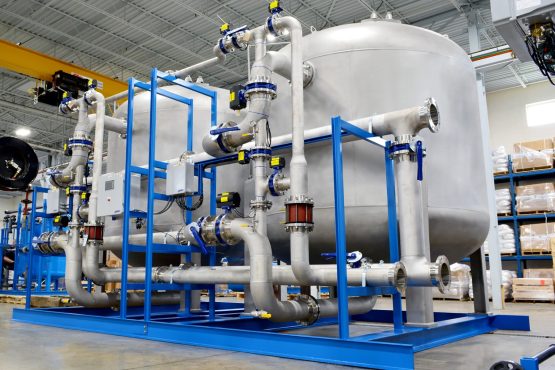
𝐂𝐚𝐭𝐢𝐨𝐧 𝐄𝐱𝐜𝐡𝐚𝐧𝐠𝐞 𝐔𝐧𝐢𝐭
- Raw water first passes through the Cation Resin Column, which replaces positive ions like
- Calcium (Ca²⁺)
- Magnesium (Mg²⁺)
- Sodium (Na⁺)
- Potassium (K⁺)
- These are replaced with Hydrogen ions (H⁺).
𝐀𝐧𝐢𝐨𝐧 𝐄𝐱𝐜𝐡𝐚𝐧𝐠𝐞 𝐔𝐧𝐢𝐭
- The partially treated water then enters the Anion Resin Column, which removes negative ions such as
- Chloride (Cl⁻)
- Sulfate (SO₄²⁻)
- Nitrate (NO₃⁻)
- Bicarbonate (HCO₃⁻)
- These are replaced with Hydroxide ions (OH⁻)